


Professor Benjamín González Díaz
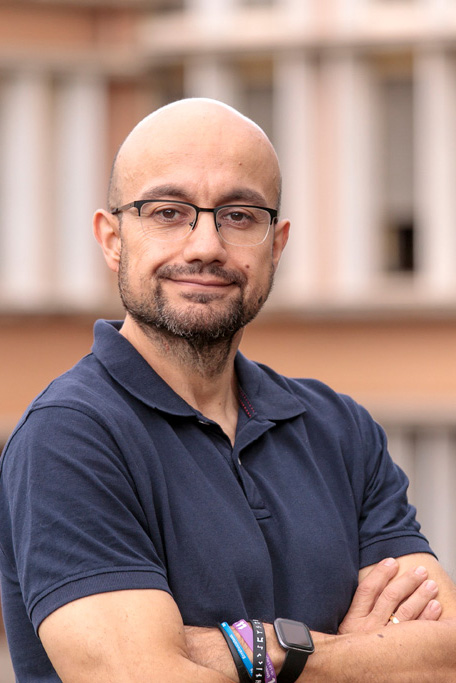
Professor Benjamín González Díaz
Benjamín J. González Díaz holds a PhD in Physics since 2008 and has been a professor in the Department of Electrical Engineering since 2011. His scientific work has focused on various aspects related to the manufacturing of renewable energy systems, grid generation and management, and the political and social implications of the energy transition. He has worked on several research projects, both internationally, nationally, and regionally.
He has worked with research teams from several countries, including in Germany at the Fraunhofer ISE, in Colombia with EAN University, and in Singapore with the Solar Energy Research Institute. He currently coordinates the Thematic Interest Group on Energy Transition within the European University Alliance StarsEU. In terms of technological development and industry collaboration activities, he has led seven initiatives and participated in another 11.
In the field of university management, he served as Coordinator of Quality and Teaching Innovation at the School of Engineering and Technology from 2016 to 2017, Director of the Sustainability and University Services Secretariat from 2017 to 2019, Director of the International Interuniversity Continuing Education Master’s Degree in Energy Decarbonization in Emerging Countries, Coordinator of the Doctoral Program in Industrial, Computer Science, and Environmental Engineering, and a member of the Academic Committee of the Master’s Degree in Renewable Energies from 2011 to 2024.
Affiliation: University of La Laguna
Education: PhD in Physics
Specialisastion: Energy
Expertise: Renewable energy
Positions: Professor with tenure track in Electrical Engineering
Teaching: Wind power; photovoltaics, fundamentals of Electrical Engineering
Orcid number, ResearchGate, Personal Website:
Selected papers
Escamilla-Fraile, Santiago, Rubén Lorenzo Cruz-González, Oscar García-Afonso, Francisco J. Calero-García, Benjamín González-Díaz, y Francisco J. Ramos-Real. «Scenario-Based analysis of energy transition for an outermost EU Territory: The case of Tenerife island». Energy Conversion and Management: X 26 (2025). https://doi.org/10.1016/J.ECMX.2025.100917.
Escamilla-Fraile, Santiago, Francisco J. Ramos-Real, Francisco J. Calero-García, y Benjamín González-Díaz. «A Review of the Energy Policy and Energy Transition Objectives for 2040 in the Canary Islands (Spain)». Energies. Multidisciplinary Digital Publishing Institute, 2023. https://doi.org/10.3390/EN16031321.
Ocaña, L. et al. (2023) «Evaluation of Ethylene-Vinyl Acetate, Methyl Methacrylate, and Polyvinylidene Fluoride as Encapsulating Materials for Perovskite-Based Solar Cells, Using the Low-Temperature Encapsulation Method in a Cleanroom Environment», Energies, 17(1), p. 60. Disponible en: https://doi.org/10.3390/EN17010060.
González-Díaz, E. et al. (2022) «Assessment of the Retrofit Strategies on Thermal Insulation Applied in Buildings Located on the Southern Border of the EU: The Case of the Canary Islands», Buildings, 12(11), p. 1994. Disponible en: https://doi.org/10.3390/BUILDINGS12111994.
Montes, C. et al. (2022) «Study of the Evolution of the Performance Ratio of Photovoltaic Plants Operating in a Utility-Scale Installation Located at a Subtropical Climate Zone Using Mixed-Effects Linear Modeling», Applied Sciences (Switzerland), 12(21). Disponible en: https://doi.org/10.3390/APP122111306.
Valizadeh, Hamed, David Cañadillas, Ricardo Guerrero‐Lemus, Jan Kleissl, y Benjamín González‐Díaz. «EDA‐based optimized global control for PV inverters in distribution grids». IET Renewable Power Generation 15, n.º 2 (2021): 382-96. https://doi.org/10.1049/RPG2.12031.
González-Díaz, B. et al. (2021) «On the road to a sustainable transport mobility in isolated power systems: The role of light-duty powertrain electrification», Journal of Cleaner Production, p. 128646. Disponible en: https://doi.org/10.1016/J.JCLEPRO.2021.128646.

Nauka zdalna
Uzyskaj dostęp do Office 365, MS Teams i poczty elektronicznej dla studentów PK
e-learning
Kursy online dla studentów Wydziału Inżynierii i Technologii Chemicznej
Oprogramowanie dla studentów
MATLAB, Azure Dev Tools for Teaching, usługa VPN dla studentów WIiTCh

Podwójne dyplomowanie
Kończąc studia II stopnia na WIiTCh, uzyskaj dyplom FH Münster
Program Erasmus+
Program wymiany studenckiej obejmującej ponad 30 krajów z Europy, czas trwania od 5 dni do 12 miesięcy
Studia cząstkowe
Kilkanaście uczelni partnerskich z całego świata w których studenci Wydziału mogą odbyć część studiów w ramach programu wymiany studenckiej

Ważne linki:
Dział Współpracy Międzynarodowej
 Ostatnio dodane:
- Cracow University Of Technology Listed In Shanghai Ranking’s Global Ranking Of Academic Subjects 2020 23 października 2023
- PK with my eyes film competition 23 października 2023
- Why you should study in Poland? 23 października 2023
Nauka zdalna
Uzyskaj dostęp do Office 365, MS Teams i poczty elektronicznej dla studentów PK
e-learning
Kursy online dla studentów Wydziału Inżynierii i Technologii Chemicznej
Oprogramowanie dla studentów
MATLAB, Azure Dev Tools for Teaching, usługa VPN dla studentów WIiTCh
Ważne linki:
Podwójne dyplomowanie
Kończąc studia II stopnia na WIiTCh, uzyskaj dyplom FH Münster
Program Erasmus+
Program wymiany studenckiej obejmującej ponad 30 krajów z Europy, czas trwania od 5 dni do 12 miesięcy
Studia cząstkowe
Kilkanaście uczelni partnerskich z całego świata w których studenci Wydziału mogą odbyć część studiów w ramach programu wymiany studenckiej
Ważne linki:
Dział Współpracy Międzynarodowej
Ostatnio dodane:
- Cracow University Of Technology Listed In Shanghai Ranking’s Global Ranking Of Academic Subjects 2020 23 października 2023
- PK with my eyes film competition 23 października 2023
- Why you should study in Poland? 23 października 2023